
LM238WR2-SPE1 sourcing for OEM equipment starts with a video-path decision: can the proposed host, controller, firmware, and harness deliver the required image to this exact panel? A quotation for a “4K controller” leaves that question open. Purchasing needs evidence that the host input and panel output work together at the approved operating mode.
Claim: A compatible conversion board is a candidate component; approval belongs to the tested video path.
Which Video Mode Must the Purchase Actually Deliver?
Which 4K Mode Must the Equipment Host Supply?
LG Display's 21 January 2019 Ver.1.0 final specification identifies a 3840 × 2160 panel. Its timing table lists 533.25 MHz typical pixel clock and 59.997 Hz typical vertical frequency. Obtain the applicable document for the offered production version before approving a timing configuration.
Ask the OEM for the host-board revision, exact output port, operating system, graphics-driver version, and required application mode. Specify RGB or another agreed color format and bit depth. A processor's headline resolution does not establish what the installed port and software can deliver.
Illustrative purchasing distinction: a board receiving 1920 × 1080 and scaling it to a UHD panel does not deliver native UHD source detail. Likewise, a 30 Hz input converted to a 60 Hz panel output does not create 60 distinct source frames each second.
Claim: The order must distinguish the host's delivered image mode from the controller's panel-output mode.
What Must the Controller Deliver to the Panel?
The referenced panel uses four-lane eDP at HBR2, 5.4 Gbit/s per lane. Require written confirmation that the populated board and supplied firmware support that output configuration with the selected timing and color depth. An HDMI input specification describes the receiving side, not the internal eDP output.
Request the configured timing record, including active pixels, horizontal and vertical totals, blanking intervals, and pixel clock. Record the board's advertised input modes separately from the panel-output settings. For a direct-eDP host, obtain equivalent configuration evidence from the motherboard supplier.
Do not treat the reference's 40–60 Hz adaptive-sync note as blanket HMI compatibility. It restricts that operation to moving pictures at 25 ± 5°C and warns about still images and reliability testing. Use an agreed fixed mode unless the alternative is specifically qualified.
Claim: Controller selection depends on the configured panel output, including timing conditions that a “4K supported” label omits.
What Evidence Releases the Complete eDP Path?
Which Harness and Power Details Must Be Approved?
CN1 is a 30-pin connector carrying the main-link lanes, AUX, HPD, and panel power. The reference specifies nominal 10.0 V logic supply, with a 9.5–10.5 V operating range. Pin count alone cannot establish cable compatibility.
Require a pin-to-pin harness drawing covering lane order, polarity, AUX, HPD, grounds, power, connector orientation, length, shielding, and routing. AUX and HPD participate in capability discovery and link management; they are not optional spare wires.
The LED driver is external, with separate six-pin CN2 and CN3 backlight connections. Identify the matched driver, current settings, dimming controls, and power sequence. Verify the delivered wiring against the applicable panel document before energizing the assembly.
Claim: Harness approval must cover signal communication and power delivery together.
How Should the Complete Path Be Tested?
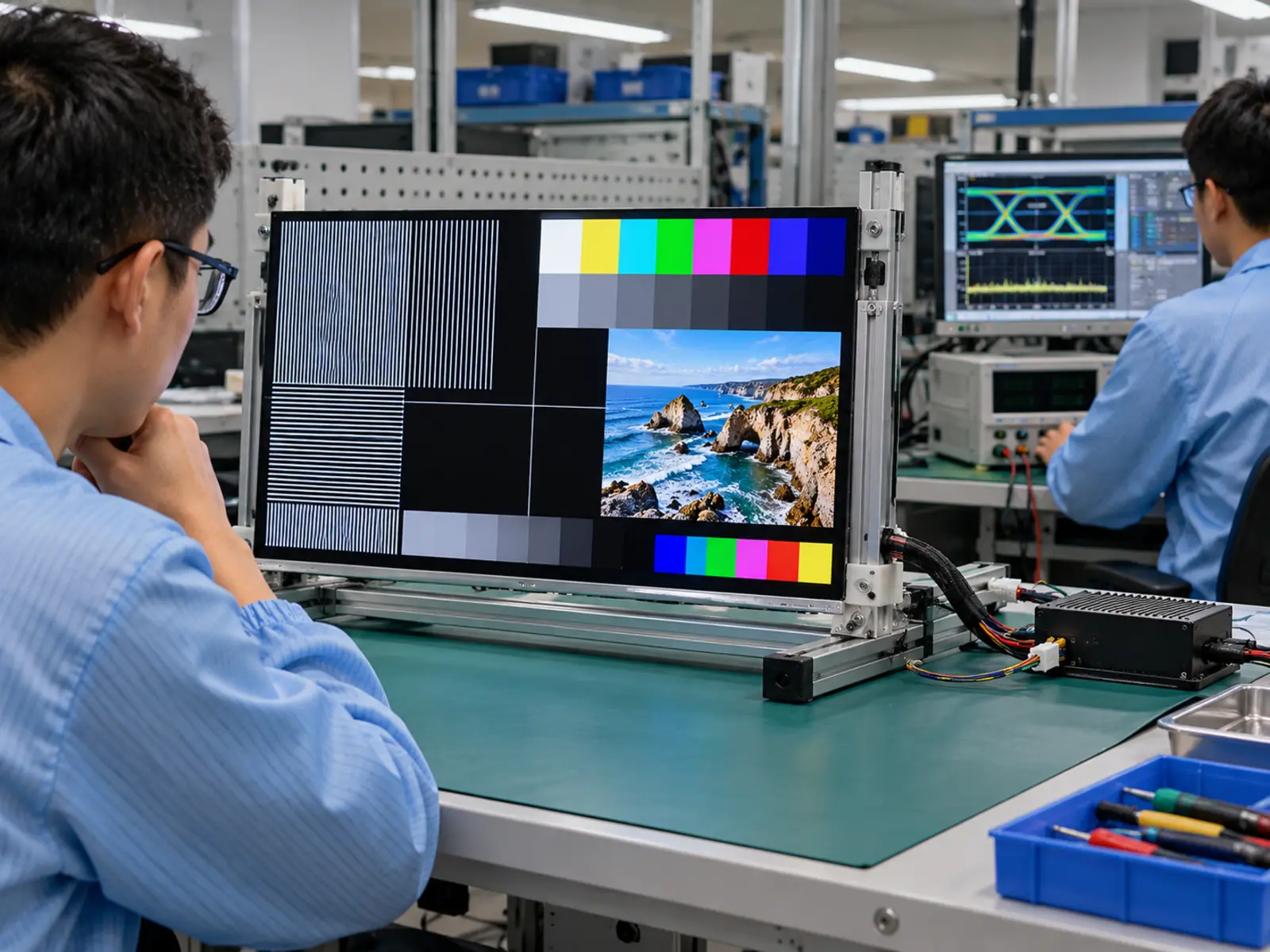
Use the intended host, production-length harness, approved supplies, and final cable routing. Retain the controller firmware identifier and evidence of the actual input and output modes.
| Check | Acceptance evidence to retain |
|---|---|
| Native image path | Mode records and pixel-mapped patterns showing no unintended scaling or cropping. |
| Startup and recovery | Results for full power removal, host restart, and applicable sleep or signal-loss recovery. |
| Equipment operation | Actual HMI pages and agreed moving patterns, with no link dropouts or visible corruption. |
Test at the agreed equipment conditions within component ratings. Freeze the successful configuration in the purchasing specification; a later board, firmware, or cable change requires review.
Claim: A bench image becomes purchasing evidence when its operating mode and complete configuration are reproducible.
What Advantages Does XIANHENG Offer for LM238WR2-SPE1 Procurement?
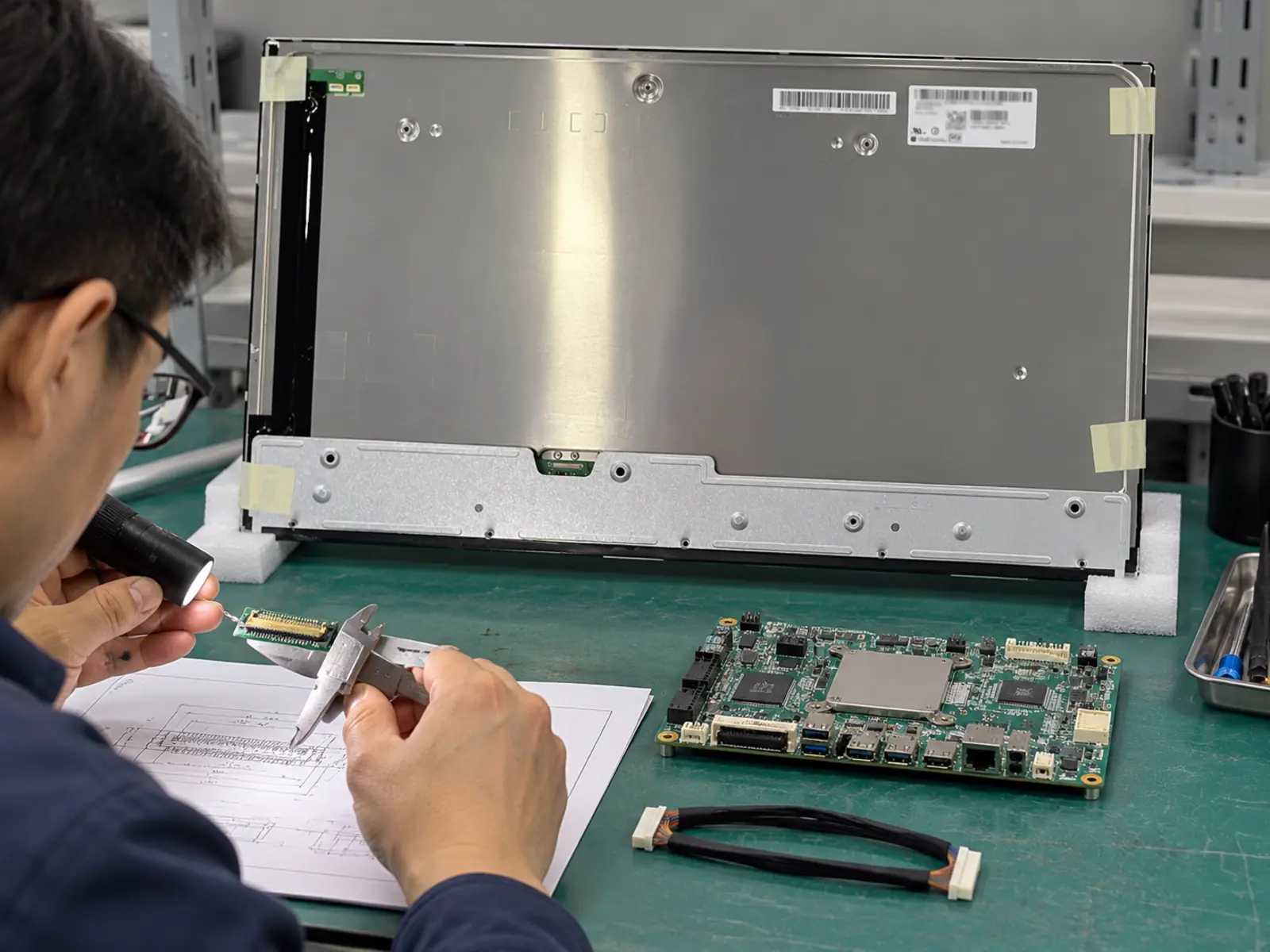
XIANHENG can review the LG Display LM238WR2-SPE1 23.8 Inch 4K UHD IPS eDP LCD alongside the host-output specification and propose a controller, firmware, harness, and LED-driver scope for sample qualification.
The standard LCD has no touch sensor. Custom PCAP touch and cover glass are separate assembly options. Include their controller and grounding arrangement in equipment testing. Standard reference luminance is 540 cd/m². XIANHENG assesses 500–1000 cd/m² customization on selected models and may evaluate higher targets for special projects. Any LM238WR2-SPE1 modification requires feasibility confirmation, revised driver and thermal checks, and an agreed measurement surface.
Provide host details, target mode, brightness, touch requirements, quantities, and drawings. Review the Industrial LCD Product Collection or reach out to XIANHENG for project review. Component selection does not establish wide-temperature suitability or completed-equipment certification.
Claim: XIANHENG can help define the proposed supply configuration; the OEM must validate its use in the equipment.


