
An LM190E0A-SLE1 replacement for legacy OEM equipment should preserve the approved HMI layout, enclosure fit, and electrical behavior. For equipment manufacturers and enterprise spare-parts buyers, another 19-inch LCD is only a candidate until these conditions are checked. Adding capacitive touch or requesting higher brightness introduces further changes that belong in the assembly specification.
Claim: LM190E0A-SLE1 becomes an approved replacement through documented compatibility checks and equipment-level sample validation.
Which Existing Parts Can the OEM Retain?
Can the Existing 5:4 Layout and Mounting Be Retained?
LM190E0A-SLE1 provides a 19-inch, 1280 × 1024 image with a 5:4 pixel format. This can suit equipment whose operator pages and front opening were designed around that format. Moving to a widescreen panel may require software scaling and enclosure changes.
Compare the original and proposed module drawings using common datums. Check the active-area position, supports, mounting points, connector access, and cable clearance. Illustrative example: a nominal 1.0 mm clearance cannot prevent interference if permitted positional errors total 1.3 mm toward the obstruction. These are example values, not this panel’s tolerances.
Claim: Preserving the 5:4 interface layout still requires a drawing-based check of the complete mechanical fit.
Will the Retained Electronics Drive the Panel Correctly?
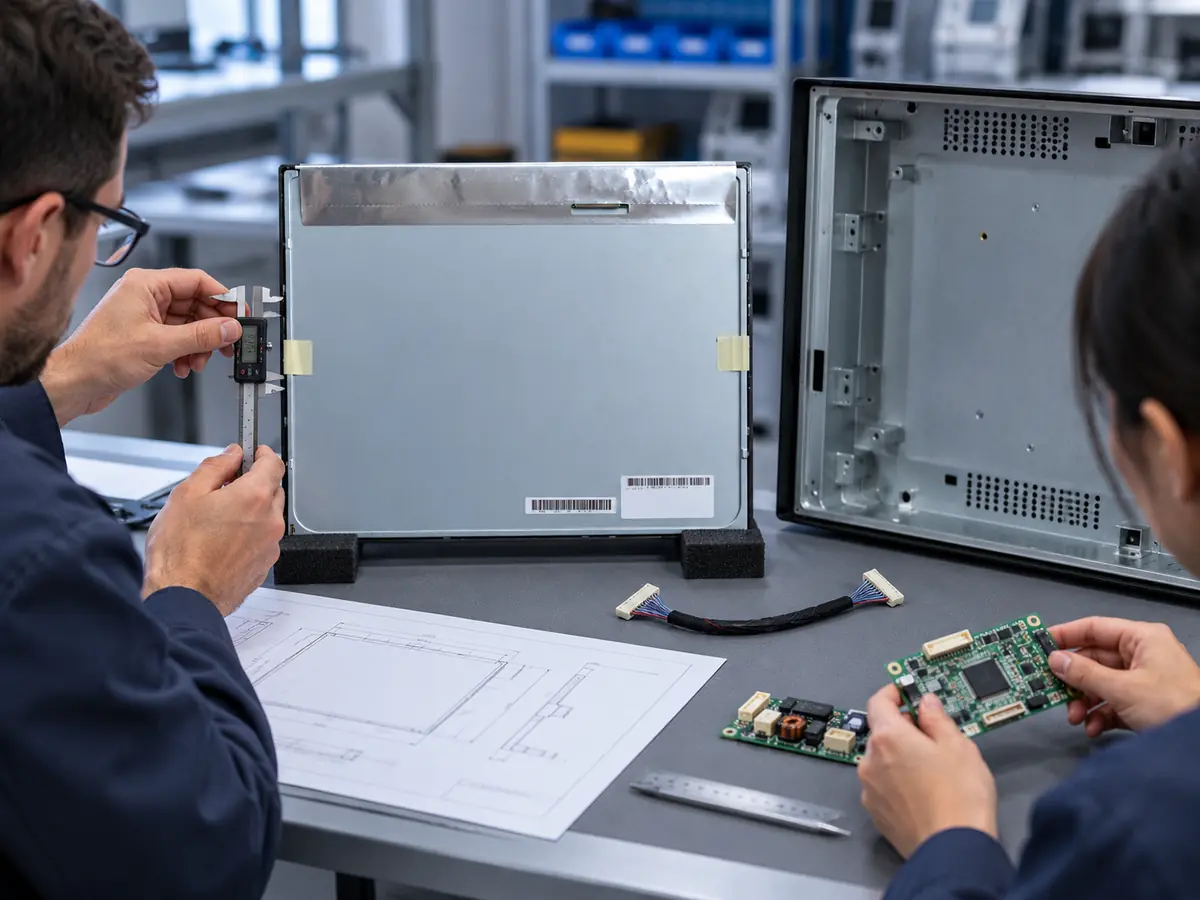
LG Display’s Ver. 1.0 specification identifies a two-port LVDS interface, a nominal 5 V panel supply, and an LED backlight requiring an external driver. Confirm the applicable specification against the offered suffix and revision before releasing wiring.
| Retained component | Compatibility evidence required |
|---|---|
| Host or video controller | Supported timing, LVDS channel arrangement, color mapping, and power sequence. |
| Panel cable | Pin-by-pin drawing, connector orientation, power connections, and routing. |
| Backlight driver | LED-string requirements, current regulation, enable signal, and dimming compatibility. |
A matching connector does not establish a matching pinout. An HDMI source requires a suitable controller between the host and LVDS panel. Verify its panel configuration rather than relying on a generic resolution label.
Claim: Retaining a controller or cable requires an electrical comparison, followed by testing with the actual host.
Which Changes Require a New Assembly Approval?
How Should Custom Capacitive Touch Be Specified?
Projected capacitive touch, or PCAP, is XIANHENG’s main direction for custom touch assemblies. It is a separate integration option, not a touch function built into the standard LM190E0A-SLE1 module.
Provide the cover-glass outline, viewing window, border printing, thickness, mounting method, touch interface, and host operating system. Declare glove and wet-surface requirements before controller selection. Replacing resistive touch with PCAP may change the controller, software integration, and front assembly.
Check coordinate alignment, edge inputs, and unintended touches with the intended gloves, final grounding, and equipment electronics operating. Cover thickness and bonding method must suit the selected touch design; controller claims alone do not prove assembled performance.
Claim: A PCAP option needs approval as a complete touch stack connected to the intended OEM host.
When Does Higher Brightness Require a Different Approval?
The referenced standard specification lists typical center luminance of 250 cd/m². XIANHENG can assess brightness customization for selected models, commonly targeting 500–1000 cd/m² (nits). Higher targets may be considered for special projects. Feasibility for LM190E0A-SLE1, the achievable brightness, and the required construction must be confirmed with XIANHENG.
Specify whether luminance is measured at the LCD surface or through the finished touch and cover assembly. A modified backlight may change driver requirements, power consumption, temperature rise, and mechanical clearance. Higher luminance alone does not establish sunlight readability or a wider operating-temperature range.
Validate startup, HMI rendering, dimming, touch operation, and temperatures in the final enclosure. Record measurement conditions and agreed optical limits. Freeze the approved panel, backlight, driver, touch stack, cables, and firmware before batch release.
Claim: A brighter assembly requires its own agreed specification and validation; the original panel rating does not describe the modification.
What Advantages Does XIANHENG Offer for LM190E0A-SLE1 Sourcing?

XIANHENG supports OEM display sourcing, component replacement reviews, and custom touch-display integration. For LM190E0A-SLE1 projects, support can include PCAP evaluation, cover-glass customization, controller and cable matching, and brightness feasibility review, subject to the confirmed design.
Send the original label, drawings, host details, target brightness, touch requirements, sample quantity, and expected batch demand. Request written confirmation of availability, configuration, inspection criteria, and substitution controls. The OEM remains responsible for completed-equipment validation.
Review the Industrial LCD Product Collection, or reach out to XIANHENG to discuss the retained equipment and proposed changes.
Claim: XIANHENG can review a defined sourcing requirement and confirm which standard or customized assembly is feasible.


