
Mining display humidity problems often appear at a particular moment: a cold machine enters a warm workshop, a parked console cools after shutdown, or a cabinet is opened during wet weather. The screen may fog even though no rain or wash water has crossed the enclosure seal.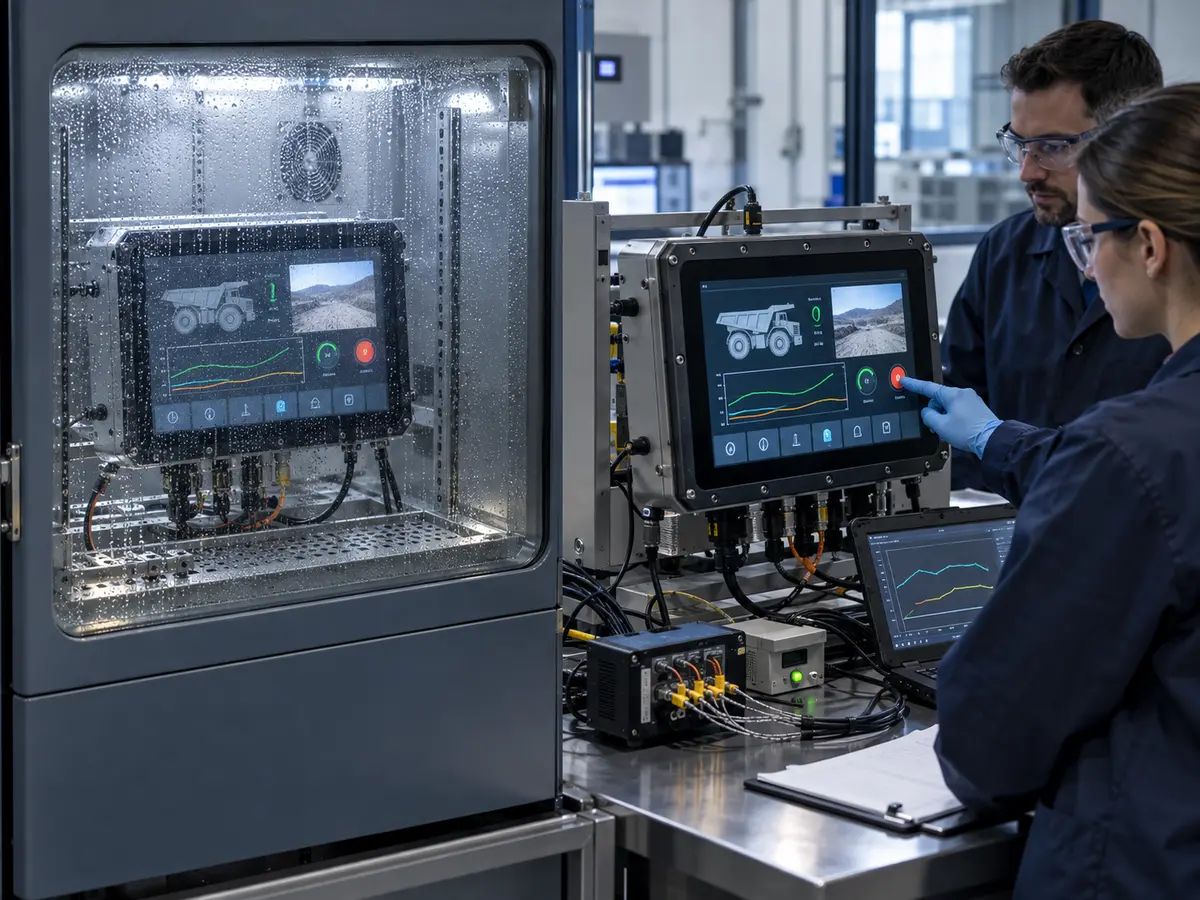
The first engineering task is to identify where the moisture is located and what changed before it appeared. Water on the outer touch surface, mist inside an optical gap, and moisture on a controller board have different causes and consequences. Treating all three as a failed waterproof seal can lead to the wrong repair.
Quick Answer: Mining displays handle humidity and condensation through a coordinated moisture and temperature strategy. Identify the source of water vapor, measure local air conditions and surface temperatures, and check when surfaces fall below the local dew point. Use suitable enclosure construction, controlled assembly moisture, application-specific venting or drying, thermal management, optical-stack design, and defined service procedures. Validate non-condensing humidity, condensation-producing transitions, external water exposure, wet-touch behavior, and recovery separately. A non-condensing humidity rating or an IP code alone does not approve operation with internal condensation.
Claim: Moisture control begins by identifying the water source, the cold surface, and the operating event that brings them together.
1. What Does the Timing of a Moisture Fault Reveal?
A fault report should describe the minutes and hours before the symptom, not only the appearance of the wet screen. Machine location, shutdown, washing, cab cooling, service access, and power state can explain why moisture appears at one stage of a shift.
Direct answer: Build a timeline linking the symptom to temperature, humidity, surface condition, power, and enclosure access. Determine whether the moisture is outside, inside an optical gap, or within the electronics compartment before changing seals or replacing the LCD.
Why Can Workshop Entry Produce Fogging?
After cold exposure, the display glass and metal can remain colder than the air in a heated workshop. Warm humid air contacting a surface below its dew point can deposit liquid water there.
External fogging may therefore occur without enclosure leakage. Opening the housing while it is still cold can also expose internal surfaces to humid workshop air. Record whether the fault begins before or after a service cover is opened.
Why Can Condensation Appear After Shutdown?
During operation, backlight and electronic losses warm the assembly. After shutdown, different parts cool at different rates, and the relative humidity of the trapped air can rise as it cools.
A front window or metal region may reach the dew point before the air sensor reports an apparently alarming condition. Check the cooling sequence and coldest relevant surfaces instead of relying only on average cabinet air temperature.
What Does Moisture after Washing Suggest?
Washing introduces possible liquid-entry paths as well as a temperature change. Water may enter through a disturbed seal, connector, vent installation, or service opening; cooling can also promote condensation where humid air is already present.
Record spray direction, water temperature, cleaning agent, closed-cover condition, and when the symptom appears. Do not assign a cause from a photograph alone. Ingress and condensation may coexist and require separate corrective actions.
How Can Cab Air Conditioning Affect the Result?
A cold air stream can cool a local surface while humid air remains elsewhere in the assembly or cab. Door opening, shutdown of air conditioning, and changing ventilation can alter that balance.
Check air-outlet direction and sensor location. A display working in dry conditioned air may behave differently when a door opens to humid outside air or when cooling continues across one part of the console.
Which Symptoms Should Be Distinguished?
A wipe that clears the outer glass identifies the visible water as external, but it does not establish the condition of the electronics. Internal haze, persistent staining, touch loss, resets, and corrosion should be recorded independently.
Preserve timestamps and inspection evidence before drying or disassembly where safe procedures permit. If the symptom disappears during transport to the service bench, the operating history may be the best remaining evidence.
| Observed Event | Mechanism to Investigate | Evidence to Capture |
|---|---|---|
| Fog at workshop entry | Cold surfaces meeting warmer humid air | Surface temperature, local dew point, cover state |
| Mist after power-off | Cooling of an assembly containing moisture | Shutdown timeline and internal temperature distribution |
| Fault following washdown | Liquid entry, cooling, or both | Spray conditions, entry traces, delay to symptom |
| Touch error on wet glass | Surface-water interaction with the touch system | Water pattern, gloves, firmware, input log |
Claim: A useful moisture investigation reconstructs the event sequence and location of water before assigning a component failure.
2. Where Can Water Vapor Remain Inside a Mining Display?
An enclosure can contain moisture without an active liquid leak. Air admitted during assembly or service, moisture held in materials, vapor transmission, and previous contamination can all contribute to its internal condition.
Direct answer: Review trapped air, moisture-bearing materials, optical cavities, connectors, and service practices. Measure local conditions and identify the surfaces that can become colder than the surrounding air.
Why Is Relative Humidity Alone Incomplete?
Relative humidity describes the air's moisture condition at its current temperature. The same air can approach saturation as it cools, so a percentage without temperature and location is an incomplete requirement.
Compare the calculated local dew point with the relevant surface temperature. For illustration, air at 30°C and 80% relative humidity has a dew point of approximately 26°C; a surface below that temperature can collect condensation.
How Can Assembly and Service Trap Moisture?
Closing a housing in humid air traps an initial moisture load. Damp cleaning residues, incompletely dried parts, or moisture held by some materials can add to it after closure.
Define appropriate component handling, cleanliness, drying, and closure conditions for the construction. Any drying process must remain within material and component limits; an uncontrolled heating step can create a second defect.
What Changes in an Air-Gap Optical Stack?
A gap between the LCD and touch or cover glass creates a cavity whose moisture and temperature conditions affect visibility. The outer glass and LCD can follow different temperatures during cooling or workshop entry.
Determine how the cavity exchanges air and how its perimeter is constructed. Do not assume that the rear enclosure sensor represents conditions inside this space or that a visually sealed edge is hermetic.
Why Do Dust and Residues Matter Electrically?
Moisture combined with ionic or other conductive contamination can reduce surface insulation resistance and contribute to leakage or corrosion. The risk depends on the contaminants, materials, voltage, geometry, and exposure.
Inspect affected boards and connectors under the approved service procedure. A unit that works after drying may still retain contamination or damage that can recur during the next humid cycle.
Does an IP Rating Exclude Internal Condensation?
No. An ingress rating addresses defined external dust and water exposure for a specified enclosure construction. It does not independently establish the amount of moisture inside or the temperature of internal surfaces.
Review the liquid sealing boundary and moisture strategy as connected but separate issues. A housing can pass an applicable ingress test yet still need a condensation assessment for its operating transitions.
Claim: Internal moisture risk depends on the initial water load, subsequent exchange, contamination, and local surface temperatures.
3. Which Moisture-Control Measure Fits the Actual Cause?
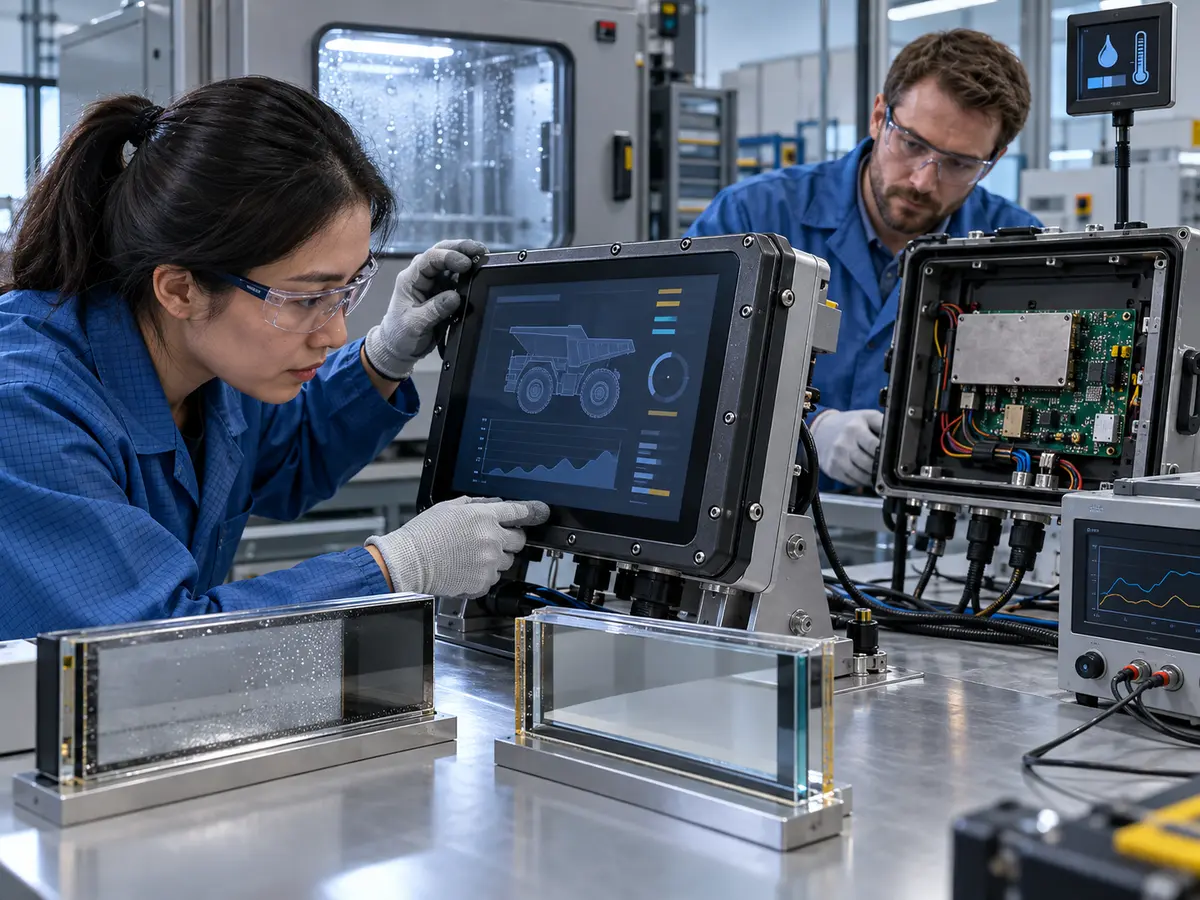
No single addition solves every moisture problem. A vent, heater, bonded optical stack, desiccant, or coating changes a different part of the system and introduces conditions that must be verified.
Direct answer: Select controls against the diagnosed mechanism: reduce liquid entry, limit assembly moisture, provide suitable vapor exchange, keep relevant surfaces above dew point where required, or protect vulnerable circuitry. Check the effects on sealing, heat, optics, touch, power, and maintenance.
When Can Protective Venting Help?
A suitable membrane vent can support pressure equalization and allow water-vapor exchange. Its effectiveness depends on membrane characteristics, area, placement, enclosure volume, contamination, and the humidity outside.
A vent is not a dehumidifier. Vapor can move in either direction, and drying depends on favorable conditions and sufficient time. Validate the selected vent and installation for the required liquid and dust protection as well.
When Is Heating Appropriate?
Controlled heating can help keep a relevant surface above the local dew point or support an approved warm-up process. Sensor position, thermal lag, power availability, and heating uniformity determine whether the intended surface is actually protected.
Heating lowers relative humidity locally but does not remove the enclosed water by itself. Consider what happens after power-off, during a heater fault, and at the hottest operating condition. The machine designer must approve associated startup permissions.
What Can Optical Bonding Address?
Filling an optical gap can remove that particular air cavity and reduce opportunities for visible mist within it. Bonding can also improve optical contrast, but the material and assembly require their own temperature, moisture, stress, and aging review.
The rear electronics compartment and other interfaces remain separate. Optical bonding does not make an entire display moisture-proof, guarantee zero vapor transmission, or eliminate external fogging on cold cover glass.
How Should Desiccants and Coatings Be Evaluated?
A desiccant has finite capacity. Its amount, moisture load, enclosure exchange, replacement interval, and handling must be defined; an unmaintained packet cannot support an indefinite dryness claim.
Suitable conformal coating may protect selected circuit surfaces, but coverage, cleanliness, curing, masked regions, connectors, inspection, and rework remain important. Coating does not dry the enclosure or protect every exposed connection automatically.
What Should the Service Procedure Require?
Define inspection, cleaning, drying, seal restoration, permitted opening conditions, and the criteria for return to use. Powering a wet unit merely to see whether it starts can worsen damage and should not replace the approved procedure.
External water and touch behavior need their own operating rules. Test the intended glass, controller, firmware, gloves, and grounding, following the interaction considerations in How Do Touchscreens Improve Mining Equipment Operation?.
Claim: Each moisture-control measure should target a defined mechanism and include its limits, failure behavior, and maintenance requirement.
4. How Should Engineers Test Humidity, Condensation, and Recovery Separately?
A humidity percentage on a datasheet is not a complete test plan. Non-condensing exposure, temperature-driven condensation, liquid ingress, and water on the touch surface answer different questions.
Direct answer: Build separate, traceable tests for the relevant mechanisms, then add representative machine transitions where needed. Use production construction, record local conditions, monitor required functions, and inspect after the defined recovery period.
What Does a Non-Condensing Humidity Test Establish?
A steady-state damp-heat method evaluates exposure to high humidity at a controlled temperature without condensation. It can assess moisture-related degradation under the specified duration and operating conditions.
It does not demonstrate operation with liquid water forming on internal surfaces. Confirm the method, specimen preparation, powered state, severity, and acceptance criteria instead of reporting only a temperature and relative humidity.
When Is a Cyclic Damp-Heat Test Relevant?
A cyclic method combines humidity with temperature changes and can produce surface condensation under the prescribed procedure. Its purpose and moisture distribution differ from a steady non-condensing test.
Select the applicable method and severities through the equipment qualification plan. Neither test reproduces every workshop transition or cab-cooling condition automatically; additional project-specific sequences may be necessary.
How Should a Workshop or Shutdown Transition Be Reproduced?
Define the initial thermal condition, surrounding humidity, transfer or ramp, power state, ventilation, cover position, and observation period. Use the production glass, enclosure, mounting, vent, and electronics.
Measure air temperature and humidity alongside relevant glass and internal surface temperatures. Record whether the test actually created the intended dew-point crossing; a chamber setpoint alone cannot establish that.
Which Functions Should Be Monitored During Exposure?
Observe optical visibility, changing image content, backlight, controller state, communication, and permitted touch behavior. Distinguish external fog obscuring an otherwise working image from an internal fault that interrupts image generation.
Define acceptable visibility, interruption, false-input, and recovery behavior before testing. A warm, dry post-test image can conceal a fault that prevented operation at the moment information was required.
What Should Recovery and Inspection Include?
Follow the specified recovery conditions, then repeat baseline image, touch, communication, and electrical checks as applicable. Inspect for staining, corrosion, optical changes, bond defects, residue, connector damage, and seal condition.
Record faults that disappear after drying rather than deleting them from the result. Repeat exposure or aging may be needed where the qualification objective concerns recurrence or long-term degradation; one successful restart is not lifetime evidence.
Which Configuration Details Need to Remain Controlled?
Control optical materials, enclosure and seals, vent type and position, drying or closure process, desiccant, coating, heater and sensors, firmware thresholds, connectors, and service instructions. Changes can alter moisture movement or local temperature.
Assign responsibility for affected tests before approving alternatives. Broader equipment responsibilities are explained in Why Does Mining Equipment Need Industrial LCD Displays?.
Claim: Moisture qualification must show which mechanism was tested, what happened during exposure, and how the exact assembly recovered.
5. What Advantages Does XIANHENG Offer for Mining Display Moisture Projects?

XIANHENG supports display projects for mining cabs, drilling consoles, processing equipment, service terminals, and replacements. Work can begin with a new environmental specification or recurring fogging, touch, or communication symptoms.
Direct answer: XIANHENG can coordinate industrial LCD comparison, touch, cover glass, bonding, controllers, cables, drawings, samples, and replacement analysis. Final enclosure moisture management, heating and ventilation logic, machine permissions, hazardous-location assessment, and equipment qualification remain with the responsible manufacturer and assessment parties.
How Can Component Humidity Specifications Be Reviewed?
Candidate review can compare temperature and humidity conditions, non-condensing limitations, storage requirements, optical construction, interface, power, and supply status. Obtain the exact model's current documentation rather than apply a family-level description to every revision.
Customers can review starting panels in the Industrial LCD Product Collection. Final approval depends on the installed subsystem and environmental plan.
Can the Optical and Touch Stack Be Coordinated?
Supported development can align LCD active area, touch sensor, glass, printed border, adhesive regions, bonding construction, and mechanical clearances. The review can distinguish an optical cavity issue from external fogging or moisture elsewhere in the enclosure.
Touch tuning and wet-surface testing should use the intended controller, firmware, glass, gloves, and grounding. Optical improvement alone does not establish reliable input under water droplets or conductive residue.
How Can Samples Support a Moisture Investigation?
A representative sample can include the intended LCD, glass, touch, bonding, controller, firmware, and cables. Initial inspection records image operation, touch mapping, startup, and configuration before customer environmental testing.
The customer can reproduce the relevant transition in its production enclosure and record local temperatures, humidity, moisture location, and function. Findings can then guide supported display-side changes and the tests those changes affect.
What Helps Analyze an Existing Fogging Problem?
Provide component models, assembly drawings, service history, photographs, timestamps, power state, cleaning conditions, and environmental measurements. State whether the moisture wipes off, lies behind the glass, or accompanies electrical faults.
XIANHENG can compare replacement options across optics, mechanics, interface, touch, power, and lifecycle. An unresolved enclosure moisture source should remain part of the project rather than be assumed cured by a new LCD.
What Information Should Customers Send to Start?
Useful inputs include the mining application, display location, environmental transitions, humidity and temperature records, enclosure, venting, heating, optical stack, cleaning and opening procedures, symptoms, test requirements, quantity, schedule, and lifecycle target.
To discuss a mining display affected by fogging, an underground-machine touchscreen, a moisture-sensitive optical stack, a bonded assembly, or a replacement project, please reach out to XIANHENG.
Claim: XIANHENG supports mining moisture projects by coordinating display-side construction and samples around a documented symptom, environmental transition, and qualification requirement.


