
M195FGE-L20 sourcing should settle two linked questions: can the retained host drive its native 1600 × 900 matrix, and will the TN image remain usable in the proposed mounting direction? A matching 19.5-inch diagonal cannot answer either. OEM purchasing needs an approved video configuration and an installation drawing that identifies the panel's physical orientation.
Claim: M195FGE-L20 purchasing requires timing and viewing-direction approval for the same equipment configuration.
Which Host Configuration Can Drive the Native Matrix?
What Must the Controller Actually Send?
The available Innolux C5 approval specification, Ver.3.4 dated 24 June 2016, identifies 1600 × 900 pixels, a 30-pin two-channel LVDS interface, and an external backlight converter. It lists 5.0 V typical panel supply; this does not define the LED driver's input supply.
Its timing table gives 60 Hz typical and 75 Hz maximum frame rate, with separate clock and blanking limits. These entries do not qualify every mode between them. Obtain the offered panel-label revision, applicable specification, controller output timing, LVDS mapping, and cable drawing. Check supply range and sequencing separately before power-up.
A controller's HDMI input capability does not establish its panel-side output. Purchasing should identify the configured board and firmware rather than request a generic FHD controller.
Claim: Release the controller against the supplied revision's complete timing and electrical requirements.
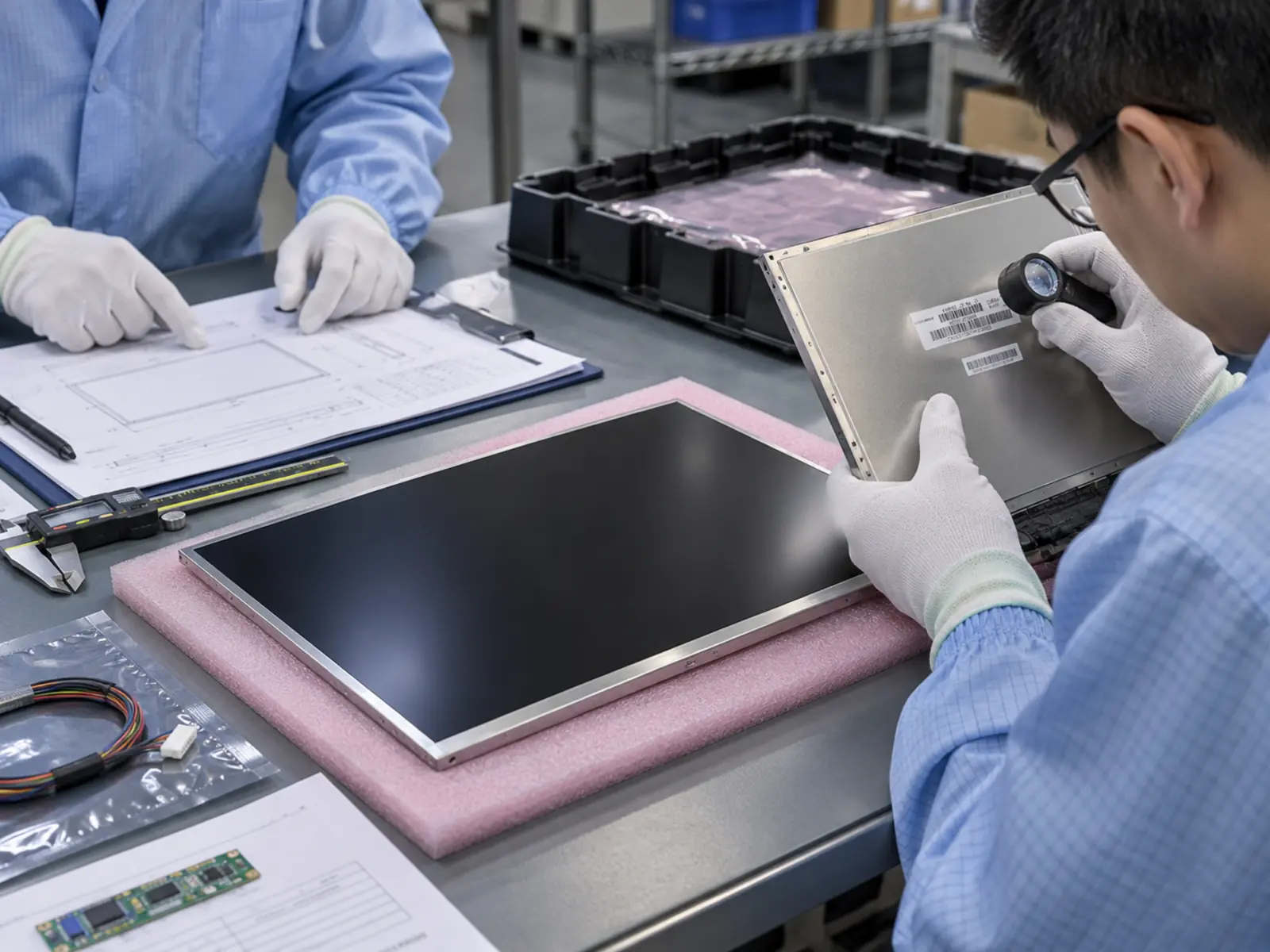
When Does a Retained FHD Interface Change the Order?
An OEM application fixed at 1920 × 1080 cannot appear pixel-for-pixel across a 1600 × 900 matrix. Choose whether the host renders a native HD+ interface or a qualified scaler reduces the source image.
Illustrative calculation: proportional reduction from 1920 × 1080 to 1600 × 900 uses a 5/6 scale factor on each axis. A 12-pixel source feature spans 10 output pixels geometrically; filtering determines its appearance. The aspect ratio remains unchanged, but fine strokes and small labels can lose definition.
If required information fails, revise the application or evaluate a native-FHD candidate. If scaling is acceptable, include the scaler settings and actual application pages in the approved supply configuration.
Claim: Retained FHD software requires an explicit rendering decision before this HD+ panel is approved.
Which Mounting Direction Can the OEM Approve?
How Should the TN Viewing Direction Be Identified?
XIANHENG lists this desktop-display panel as TN, with a 6 o'clock preferred viewing direction. Confirm that reference against the offered revision's orientation diagram. Identify the corresponding chassis edge from the defined front view rather than assuming whichever edge faces downward in the enclosure establishes the viewing direction.
The C5 optical table specifies viewing angles using contrast thresholds. Those limits do not establish stable grayscale or alarm-color recognition throughout the stated angles.
Mark panel top, connector location, image top, and operator positions separately. A physical 180° turn changes which optical direction faces an observer. Rotating the video restores upright content but leaves that physical change in place. Portrait installation likewise requires a new viewing assessment.
Claim: The installation drawing must preserve the relationship between panel orientation and required observation positions.
What Must the Orientation Trial Prove?
Build the sample with the intended brackets, cover, host, controller, and cable. Verify pixel mapping with edge markers and alternating-pixel patterns, then inspect production pages from the specified standing, seated, and service positions.
Compare dark-gray steps, status colors, small values, and disabled controls under intended lighting. Record any lost distinctions when viewing from above or below. Agree acceptance criteria before testing; photographs alone cannot replace the required visual or instrument assessment.
If one mounting direction fails, assess permitted tilt or placement changes before release. Where several required positions remain unacceptable, evaluate a wider-viewing candidate. For added PCAP, verify coordinate rotation separately. Retain the accepted orientation, firmware, page set, and results with the order.
Claim: Approve the orientation that passes the equipment's viewing tasks, with changes retested before volume purchasing.

What Advantages Does XIANHENG Offer for M195FGE-L20 Qualification?
XIANHENG can review the Innolux M195FGE-L20 19.5 Inch HD+ TN LCD Panel with host modes, panel-label photographs, installation drawings, and operator positions, then propose control hardware, firmware, and cables for sample qualification.
The bare LCD excludes touch. Custom PCAP, printed cover glass, and bonding can be assessed around the accepted orientation. Standard reference luminance is 250 cd/m²; 500–1000 cd/m² customization is assessed for selected models, with M195FGE-L20 feasibility requiring confirmation. Driver, power, heat, and brightness at the agreed final measurement surface need review. Additional brightness cannot correct an unsuitable TN viewing direction or establish wide-temperature qualification.
Send target brightness, installation conditions, touch requirements, and quantities. Review the Industrial LCD Product Collection or reach out to XIANHENG to define the sample scope.
Claim: XIANHENG can help specify the proposed assembly for OEM timing and orientation approval.


