
A mining display temperature range should describe when the operator can use the HMI, not simply which temperatures the LCD can survive. A haul truck left unpowered overnight, a drill restarting in a sun-heated cab, and a loader entering a warm workshop after a cold shift present different thermal tasks.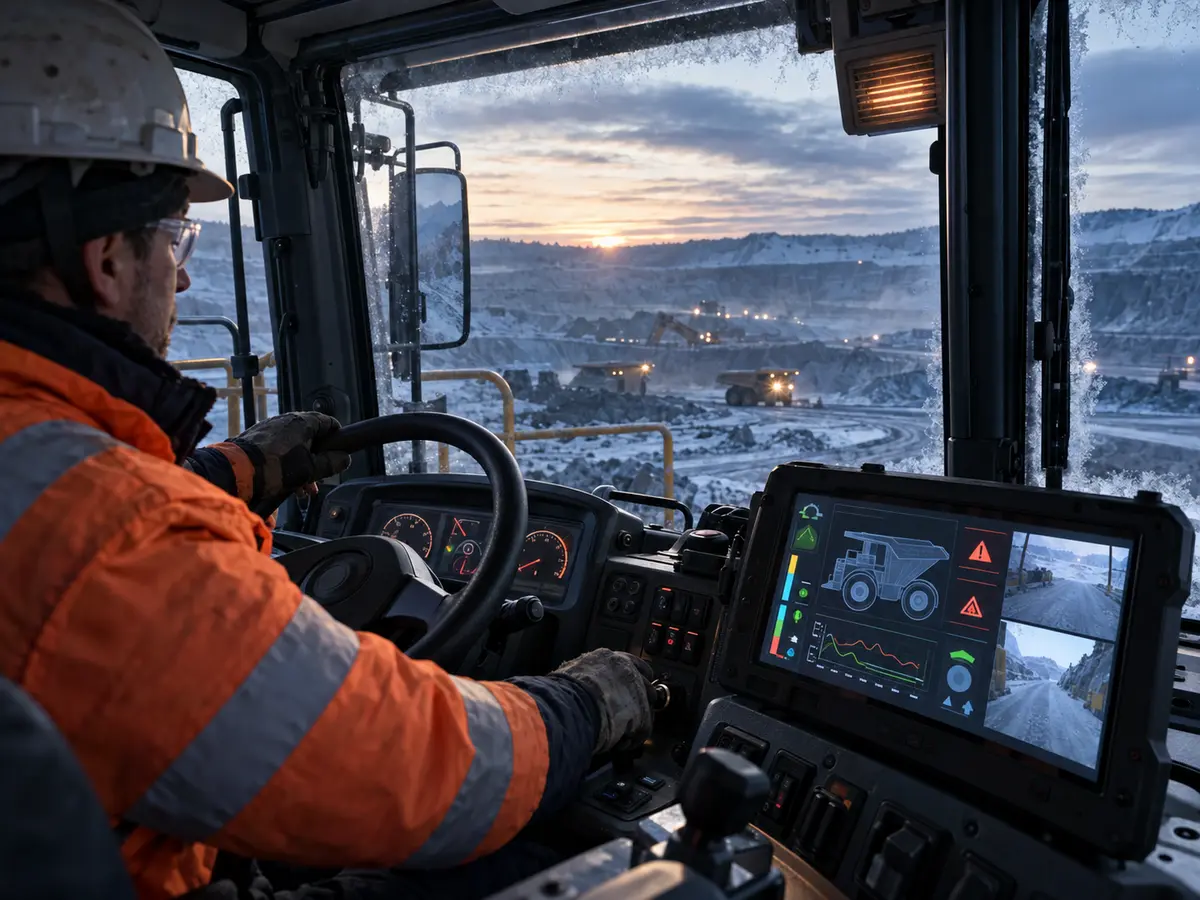
The important question is what happens at each task: when the first usable image appears, whether a changing value remains legible, whether touch coordinates stay correct, and whether the display recovers after a power interruption. A screen that works after thirty minutes of warming may not meet equipment that must present information immediately.
Quick Answer: There is no universal mining display temperature range. Around -20°C to +70°C is a useful panel-screening range for many protected industrial installations. More demanding mobile or exposed projects may evaluate -30°C to +80°C, or other supplier-defined ranges. These numbers are selection examples, not mining standards. Specify operating, unpowered storage, cold-start, hot-restart, transition, and recovery conditions separately. The approved range must cover temperatures measured at the LCD, backlight, touch system, controller, power components, and optical materials inside the actual equipment.
Claim: A mining display is temperature-qualified only when its required information and permitted inputs remain usable throughout the specified machine operating cycle.
1. Which Machine States Define the Mining Display Temperature Range?
The site weather report is an input, but it does not describe the component temperature. Equipment can remain parked without heating, operate with cab air conditioning, stop with its electronics still energized, or restart before the enclosure has cooled.
Direct answer: Build the requirement around parked storage, first power-up, normal operation, full-load operation, short shutdown, environmental transition, and abnormal thermal conditions. Give each state its temperature, duration, power status, permitted delay, and required HMI behavior.
How Does Overnight Parking Change the Lower Limit?
After a sufficiently long unpowered period, the display assembly can approach the temperature surrounding the machine. A cab heater may warm the air quickly while the glass, frame, LCD, and rear electronics remain cold.
The specification should say whether the screen must start at that cold-soaked temperature or may wait for a monitored warm-up. Otherwise, an apparently suitable panel can pass storage requirements while failing the operator's first-start task.
Why Is a Short Hot Shutdown Different from Continuous Operation?
Fans, air conditioning, or pumps may stop when the machine is parked, while retained heat and sunlight continue warming the console. The display may therefore experience a different thermal distribution during shutdown than during travel.
A hot-restart requirement should cover the credible pause between shifts, service stops, and refueling. Restarting a controller in a warm chamber does not reproduce a console with a hot front window and a cooler rear board.
What Changes When Equipment Moves Between Locations?
A loader moving between an outdoor yard and a heated workshop can encounter both temperature change and moisture. Surface equipment transported to another mine may face a different seasonal range, altitude, enclosure ventilation condition, or storage period.
Underground installations also need location-specific conditions. Depth alone is not a temperature specification; ventilation, water, nearby machinery, duty cycle, and the actual mounting position determine the environment experienced by the display.
How Should Operating and Storage Ratings Be Read?
The operating rating describes operation under the supplier's stated conditions. The storage rating concerns unpowered exposure and may include restrictions on humidity, duration, packaging, or recovery. Neither should be interpreted beyond the datasheet definition.
For example, an LCD rated for storage below its operating minimum is not automatically approved to start at the storage minimum. Check response-time conditions, optical specifications, backlight requirements, and any warm-up notes separately.
| Machine State | Temperature Evidence | Required Display Behavior |
|---|---|---|
| Overnight parking | Unpowered component temperatures after stabilization | No damage; defined first-start or warm-up rule |
| First ignition | LCD, driver, controller, and supply during startup | Usable image and input within the specified time |
| Full-load shift | Steady temperatures with production brightness and host load | Readable data, stable touch, no unplanned reset |
| Short hot stop | Heat retention after cooling stops | Predictable hot restart and fault indication |
| Workshop entry | Surface temperature and moisture conditions | Defined condensation handling and recovery |
Claim: The temperature requirement should identify machine states and their functional obligations before a panel is selected.
2. What Must Work Before the Cab Reaches a Comfortable Temperature?
Cold qualification should begin with the information needed at first ignition. Waiting for the cab to become comfortable can conceal a display limitation that matters during startup, inspection, or fault diagnosis.
Direct answer: Define the maximum delay to a valid image, acceptable response to changing information, brightness, touch readiness, startup power behavior, and any thermal interlock. A permitted warm-up must be explicit and coordinated with equipment operation.
Why Can a Static Image Hide a Cold-Response Problem?
Liquid-crystal response generally slows as temperature falls. A stationary logo or menu can look acceptable while changing digits, moving symbols, video, or alarm transitions leave trails or become difficult to distinguish.
Test the actual information rate. A slowly changing maintenance value and a camera scene used during maneuvering have different acceptance needs. Panel survival and basic image formation do not establish that both tasks remain usable.
How Should the First Usable Image Be Defined?
Measure from a defined event, such as application of the specified supply or the host's startup command. The endpoint should be valid operational information, not a lit backlight, boot splash, or frozen previous page.
Record whether communications are established, values are fresh, the machine mode is correct, and fault states are visible. If information is unavailable during warm-up, its absence should not resemble a normal operating condition.
What Happens to Touch During Cold Startup?
Touch performance depends on the sensor, controller, cover construction, firmware, mechanical stress, gloves, and surface condition. Temperature qualification must therefore include coordinate accuracy, required force where relevant, false inputs, and enumeration or driver startup.
Do not claim glove or cold-weather performance from the LCD rating. The complete touch stack should be checked with the approved gloves and operating tasks. Related interaction requirements are covered in How Do Touchscreens Improve Mining Equipment Operation?.
When Can a Heater Be Part of the Solution?
A heater can support projects whose startup conditions exceed the selected subsystem's unheated capability. Its design needs defined power, placement, insulation, sensing, warm-up time, electrical protection, and temperature distribution.
Heating the rear enclosure does not prove that the LCD's coldest region has reached the release temperature. Avoid local hot spots, and determine how operation changes after heater failure or a disconnected sensor. The responsible machine designer must approve those responses.
How Should Warm-Up and Machine Permission Be Coordinated?
If required information is unavailable until warming completes, specify what equipment functions remain permitted. The display supplier should not invent a machine interlock or imply that an HMI alone performs a safety function.
Where a delay is accepted, provide a clear state indication, a release criterion based on the relevant measurement, and a documented timeout response. Repeated power cycling should not bypass the condition or restart an endless warming loop without diagnosis.
Claim: Cold-start approval requires timely, valid information and tested inputs; a visible logo or eventual room-temperature recovery is insufficient.
3. Where Does Heat Accumulate During a Mining Shift?
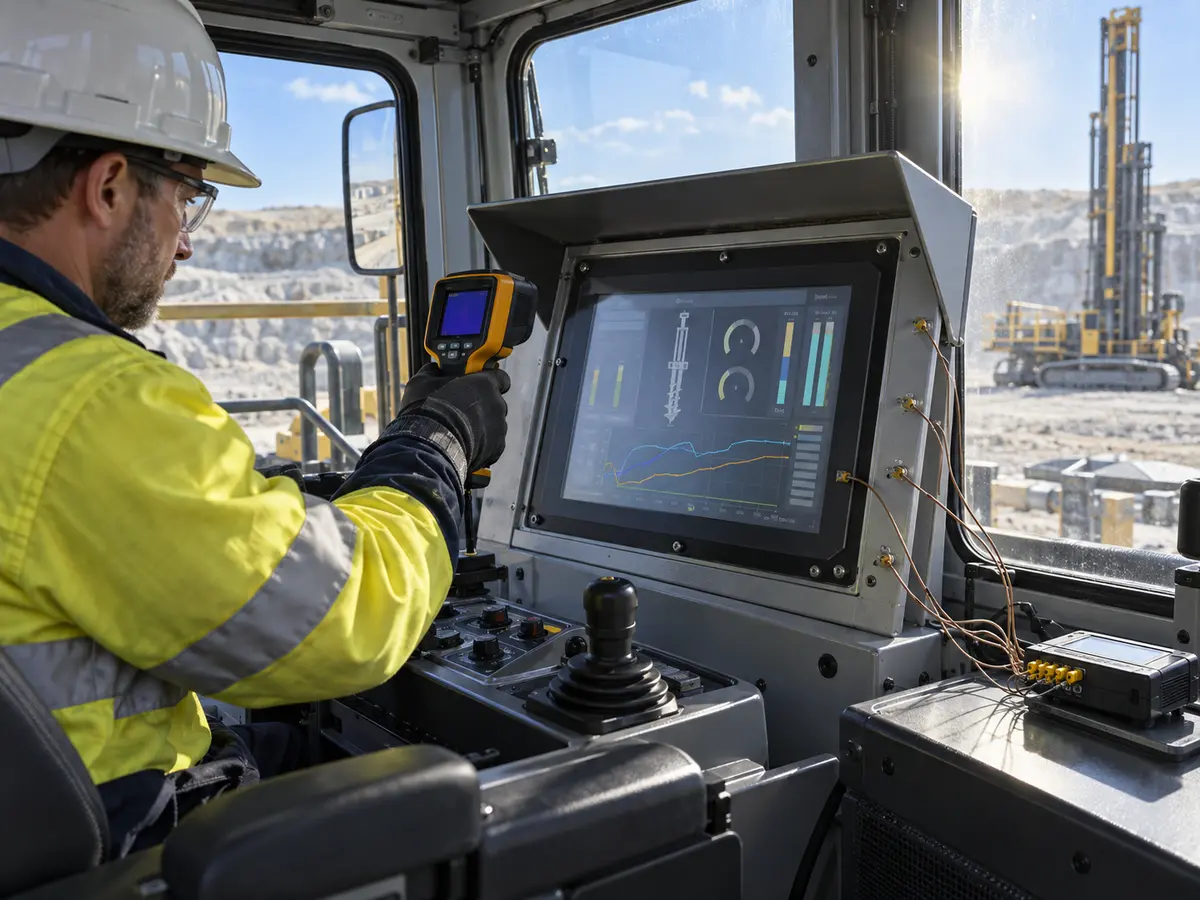
The upper temperature boundary is often set by an installed heat path rather than outside air. Sunlight heats the front surface, backlights produce heat behind it, and processors or power components may warm a shared enclosure.
Direct answer: Measure the display's front and rear thermal conditions under the intended brightness, host workload, enclosure, cooling, and machine state. Then establish whether each component stays within its approved conditions and required performance.
Why Can the Front Glass Be Hotter than Cab Air?
Direct sun through a window can heat cover glass, printed borders, bezels, and the underlying assembly unevenly. An air-temperature sensor on the dashboard may miss that local load.
Sensor placement should follow the question being answered. A rear-board sensor may protect electronics but cannot by itself establish the temperature of a sunlit LCD region. Document the measurement location and installation geometry.
How Does High Brightness Change the Thermal Budget?
Backlight power contributes to the assembly's heat balance. A panel evaluated at a moderate setting can behave differently when operated at its maximum approved brightness for a long surface-mining shift.
Brightness reduction may control temperature, but it also changes readability. Test the derated setting under the lighting condition that triggers it, with the production cover glass, touch layers, reflections, and HMI pages.
Which Cooling Assumptions Need to Be Challenged?
Review blocked vents, dirty filters, reduced airflow, fan failure, a parked machine, and loss of cab cooling where these are credible design conditions. A sealed console may depend on conduction through brackets and enclosure walls rather than outside-air exchange.
Dust protection and thermal control must be considered together. Adding a vent or fan changes sealing, maintenance, power, and reliability. Increasing the panel's temperature rating does not create a heat path.
Can Optical Materials Set a Narrower Limit than the LCD?
Bonding materials, polarizers, printed inks, touch layers, gaskets, cables, and adhesives have their own temperature and aging conditions. Differential expansion can load the LCD, change touch behavior, or affect a bonded assembly.
Check the mechanical stack at its assembly tolerances, not only its nominal drawing. Glass and metal need suitable support and clearance; excessive clamp force can become more damaging when temperature changes their relative dimensions.
What Should Thermal Derating and Recovery Look Like?
Define when output is reduced, which information remains visible, how an overtemperature state is reported, and when normal output returns. Use a stable recovery rule so that the backlight does not repeatedly rise and fall near a threshold.
The controller, host software, and machine controls should agree on the state. A protective shutdown may protect hardware yet leave the operator without required information; its equipment-level consequences need an explicit review.
Claim: Hot-operation approval depends on the measured heat path and the performance remaining after thermal controls act, not just the LCD's upper rating.
4. How Should a Thermal Test Reproduce the Machine Duty Cycle?
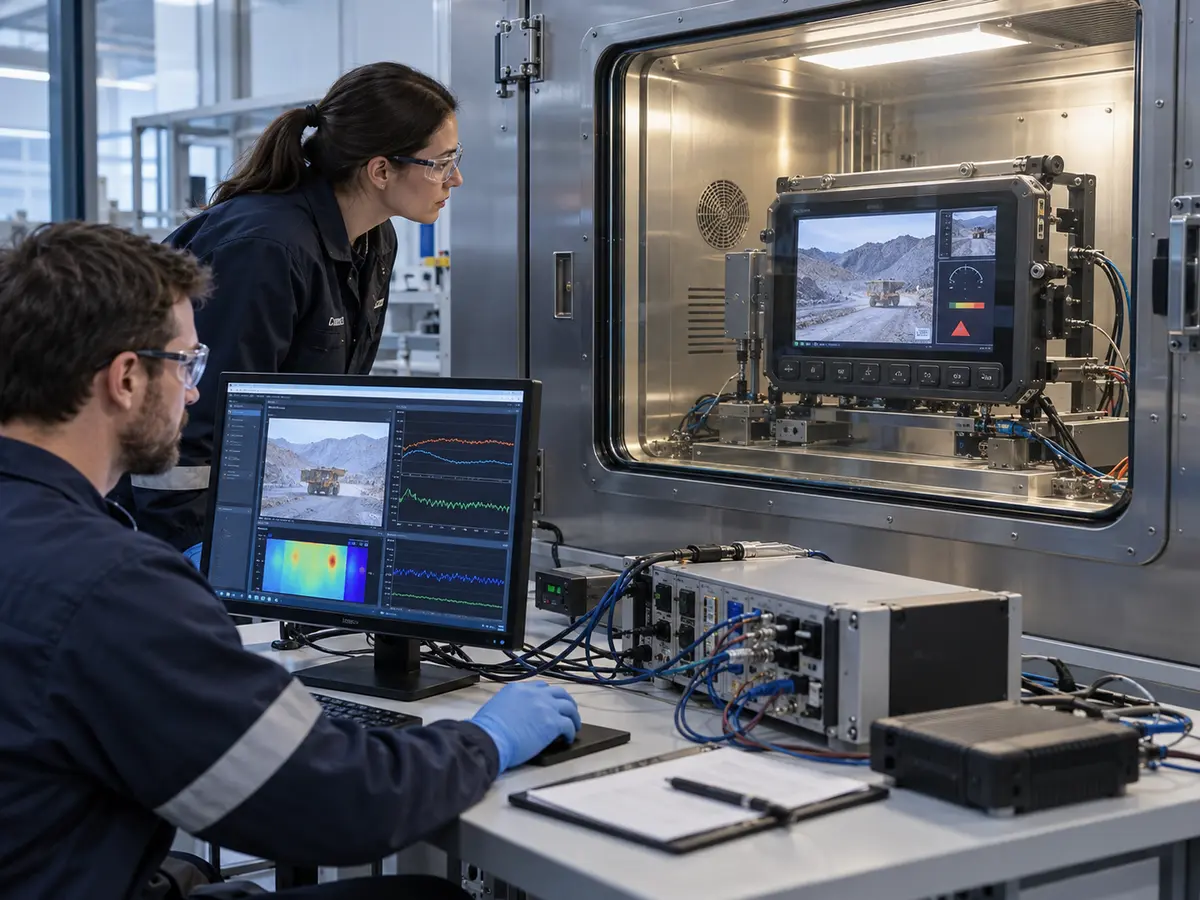
A chamber test is useful when the specimen, sequence, instrumentation, and acceptance criteria represent the equipment. Testing a bare panel continuously powered at two endpoints leaves storage, first ignition, hot restart, and transitions unanswered.
Direct answer: Create a sequence that includes unpowered conditioning, startup at the specified boundary, powered stabilization, changing HMI tasks, shutdown, restart, transitions, and recovery. Record actual component temperatures and functional evidence throughout.
How Should Conditioning and Stabilization Be Defined?
Use the agreed test procedure to determine dwell and stabilization rather than assuming a fixed chamber duration warms or cools every component equally. The enclosure, glass mass, insulation, and mounting can create substantial delays.
Record chamber air and selected specimen temperatures. Sensor attachment must not introduce a misleading reading or materially change the heat path. Capture the production configuration and the measurement method in the test record.
Which Tasks Should Run at the Temperature Boundaries?
Use production pages showing changing values, alarm transitions, trends, permitted touch controls, and camera content where applicable. Check readability, response, refresh, brightness, touch accuracy, communication continuity, and recovery.
Specify limits before testing. “Looks normal” is not a repeatable criterion. Record usable-image time, task errors, abnormal artifacts, resets, input loss, and any behavior requiring a manual power cycle.
Why Are Temperature Changes a Separate Test Question?
Stable cold and stable heat tests do not answer how the assembly responds to temperature changes. Cycling can reveal stress from expansion differences, connections affected by movement, or optical defects that appear after repeated exposure.
Select transition rate, dwell, endpoints, cycle count, and powered states from the installation and qualification plan. Do not impose a severe rapid-transfer test merely because it is available, or treat a mild cycle as evidence for an untested transition.
How Should Condensation Be Addressed?
A cold surface exposed to warmer humid air can collect condensation when its temperature is below the local dew point. This may affect optics, touch, electronics, and connectors independently of the dry temperature rating.
If the datasheet specifies non-condensing conditions, a dry chamber pass does not approve wet operation. Define prevention, drainage, enclosure management, inhibited startup, or recovery as appropriate to the equipment; verify the selected approach separately.
What Should Be Inspected After Recovery?
Repeat baseline image and touch checks after the agreed recovery period. Inspect for persistent discoloration, mura, bubbles, separation, glass damage, gasket movement, cable strain, and changes in brightness or touch mapping.
Also preserve failures that disappear after warming. An intermittent fault during the boundary condition remains relevant even when the assembly later returns to normal. Inspection after recovery cannot replace monitoring during exposure.
How Should Changes Be Controlled After Qualification?
Control the panel revision, backlight, power circuit, controller firmware, touch controller, optical stack, mounting, cooling, sensors, thermal thresholds, and startup software. A replacement with wider catalogue limits may still change power or mechanical behavior.
Review affected tests whenever those items change. Broader system responsibilities are covered in Why Does Mining Equipment Need Industrial LCD Displays?.
Claim: Thermal evidence should follow the equipment sequence, include functions during exposure, and remain traceable to the tested production configuration.
5. What Advantages Does XIANHENG Offer for Mining Display Temperature Projects?
XIANHENG supports display selection and integration for mining-machine cabs, drilling consoles, loading equipment, processing machinery, fixed stations, and replacement projects. The work can begin with an environmental requirement, an enclosure drawing, or an existing panel whose field behavior needs review.
Direct answer: XIANHENG can coordinate industrial LCD comparison, touch, cover glass, bonding, controllers, backlight control, cables, drawings, samples, and lifecycle planning. Final machine permissions, thermal protection, enclosure design, hazardous-location suitability, and equipment approval remain with the responsible manufacturer and assessment parties.
How Can XIANHENG Compare Wide-Temperature Panels?
Candidate review can compare operating and storage limits alongside resolution, interface, luminance, response specifications, power, outline, and supply status. Customers can review starting options in the Industrial LCD Product Collection.
The selected model should be checked against its current datasheet and project conditions. A family description or a similar model's rating should not be carried across to the purchased panel without confirmation.
Can XIANHENG Coordinate the Complete Display Stack?
Supported project work can include PCAP or resistive touch, cover construction, bonding method, controller, firmware, backlight driver, and cables. These elements should be reviewed together because their temperature limits and mechanical behavior may differ.
Drawings can identify clearances, support points, connector positions, and material interfaces for the customer's enclosure review. The final thermal design should use measured installed conditions rather than assume the assembly inherits the LCD rating.
How Can Prototype Samples Support Qualification?
A representative sample can establish image operation, touch mapping, dimming, startup behavior, and delivered configuration before equipment testing. The sample should include the intended glass, bonding, electronics, cables, and firmware where these influence the result.
The customer can then run the approved cold-start, hot-restart, cycling, moisture, and recovery sequence. Recorded findings allow supported display-side changes to be reviewed before production release.
What Helps a Temperature-Related Replacement Project?
Provide original component models, datasheets, mounting drawings, firmware information, supply behavior, measured temperatures, failure timing, and photographs. State whether the fault appears immediately, after warming, at maximum brightness, or only following a transition.
XIANHENG can compare replacement candidates and identify interface, mechanical, optical, power, and lifecycle differences. A nominally wider-range substitute should still undergo the tests affected by those differences.
What Information Should Customers Send to Start?
Useful inputs include the mining application, geographic conditions, parked duration, startup deadline, measured component temperatures, enclosure, solar exposure, brightness duty, host, supply, touch method, cooling, warming strategy, test requirements, quantity, and service-life target.
To discuss a wide-temperature mining LCD, cold-start HMI, sun-heated cab display, integrated touch assembly, or obsolete-panel replacement, please reach out to XIANHENG.
Claim: XIANHENG supports temperature projects by coordinating display-side components and samples around the customer's defined machine duty cycle and qualification evidence.


