
An industrial robot display is rarely an isolated component. It may combine a TFT LCD, touchscreen, cover glass, bonding, display controller, cables, enclosure, software, and grounding design. If these elements are selected independently, a suitable-looking screen can still produce an unstable image, inaccurate touch, or an avoidable redesign.
Requirements also differ across teach pendants, controller cabinets, cobots, vision systems, mobile robots, and retrofits. The solution may be a bare LCD, touch display assembly, open-frame unit, or complete monitor, depending on the architecture, workflow, space, environment, and service life.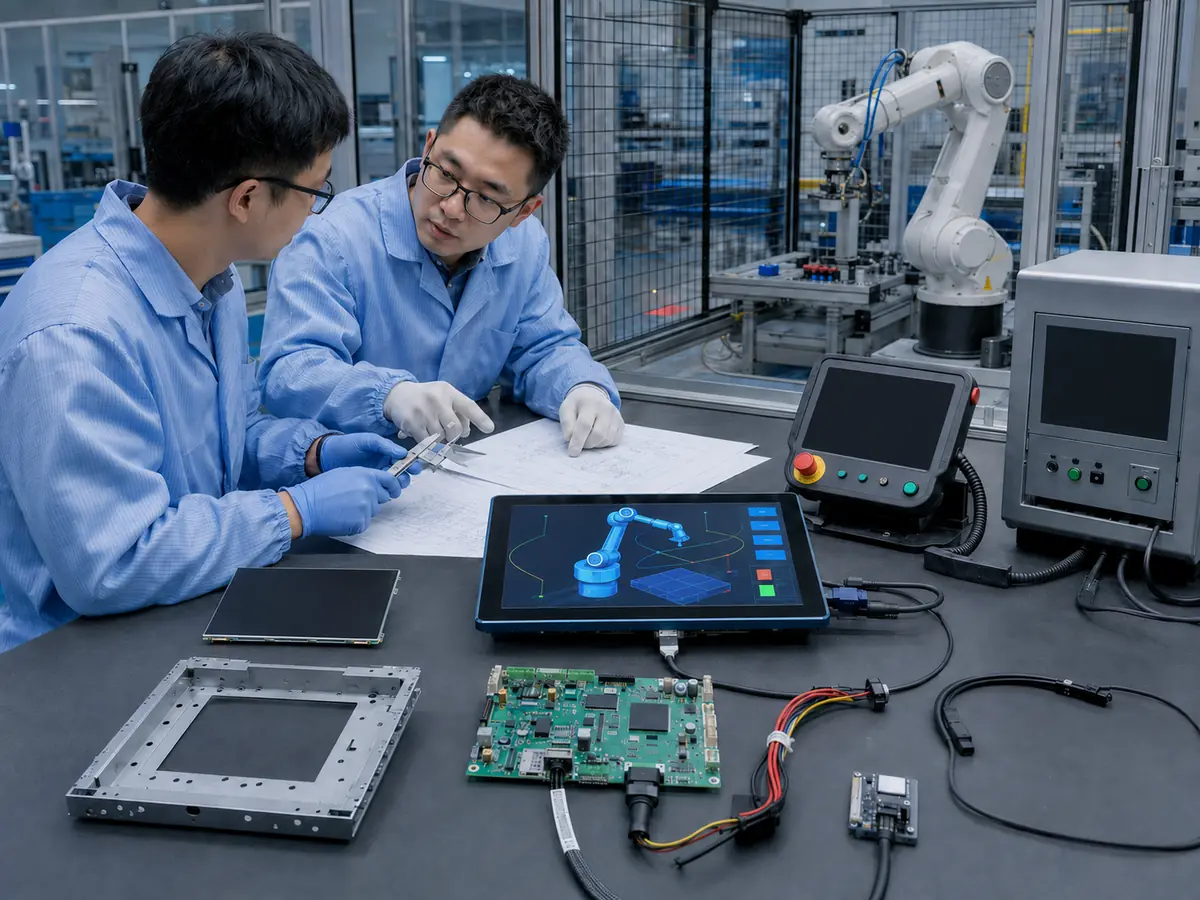
XIANHENG coordinates display selection and customization as one engineering process. Work can begin with an early requirement, existing host, mechanical drawing, or obsolete screen. The objective is to define a practical subsystem, identify compatibility risks, prepare samples, and maintain the approved production configuration.
Quick Answer: XIANHENG can support industrial robot manufacturers with industrial TFT LCD selection, PCAP or resistive touchscreen development, customized cover glass, air or optical bonding, controller boards, interface review, firmware coordination, customized cables, mechanical integration, sample assemblies, production inspection, obsolete-display replacement, and lifecycle planning. The final display must still be validated by the robot manufacturer in the intended host, enclosure, software, electrical environment, and operating conditions.
Claim: Effective industrial robot display support requires coordination across the LCD, touch interface, mechanics, electronics, software, environment, production controls, and supply lifecycle. Selecting a panel model alone does not complete the engineering work.
1. What Display Challenges Do Industrial Robot Manufacturers Need to Solve?
A robot HMI must fit the equipment while remaining readable, responsive, electrically stable, and serviceable. These requirements affect one another. Increasing the display size may improve information layout but require a new enclosure, more backlight power, a different interface, and revised HMI scaling.
Direct answer: Industrial robot manufacturers need to align the display with the operator task, host output, mechanical structure, touch method, ambient light, temperature, vibration, electrical noise, cleaning conditions, production plan, and service period. They must also control the complete approved assembly so that an unreviewed panel, cable, firmware, or touch-controller change does not alter field behavior.
Why Must the Project Start with the Robot Application?
A teach pendant needs manageable weight, balanced handling, a clear safety-control area, and robust cable retention. A cabinet HMI can use a larger display but must fit the door opening, gasket, internal depth, and service space. A vision station may prioritize resolution and image area, while an AMR interface must remain usable at a lower mounting height without obstructing sensors or maintenance access.
This is why the role of the screen should be defined before a model is chosen. Local operation, teaching, alarm review, diagnostics, maintenance, and recovery are discussed in Why Do Industrial Robots Need Industrial LCD Displays?.
Why Is the Display a Subsystem Rather Than One Part?
The LCD produces the image, but the host must provide compatible timing and power. The touchscreen uses its own controller, firmware, connection, and grounding. The cover glass changes optical and touch behavior. Bonding affects stack thickness and readability. Cables influence signal integrity and assembly. The enclosure affects sealing, temperature, mechanical stress, and EMC performance.
A supplier therefore needs enough information to review these relationships. A panel selected only by diagonal size, resolution, or connector family may fail because the active area, pin definition, voltage, startup sequence, backlight control, touch mapping, or mounting details are different.
What Information Should Be Defined Before Selection?
Useful inputs include the robot type, display location, user roles, HMI functions, viewing distance, required size or available opening, resolution, aspect ratio, brightness, viewing angle, host output, operating system, touchscreen method, gloves, cover-glass drawing, cable direction, available depth, power supply, temperature, vibration, contamination, annual quantity, development schedule, and expected lifecycle.
For an existing robot, the original LCD, touchscreen, controller, cables, drawings, firmware, and working equipment provide valuable evidence. Photographs help orientation, but they cannot replace datasheets, connector definitions, and electrical measurements.
Screen size and HMI layout should be reviewed together because diagonal measurement does not define physical text, alarm, or touch-target dimensions. Application patterns for compact screens, pendants, controller panels, and vision stations are compared in What Display Sizes Are Common in Industrial Robots?.
Claim: The first display decision should define the complete robot HMI requirement. Application, physical layout, electronics, touch behavior, environment, production, and service conditions must be documented before the display subsystem is approved.
2. How Can XIANHENG Support LCD, Touchscreen, and Mechanical Customization?
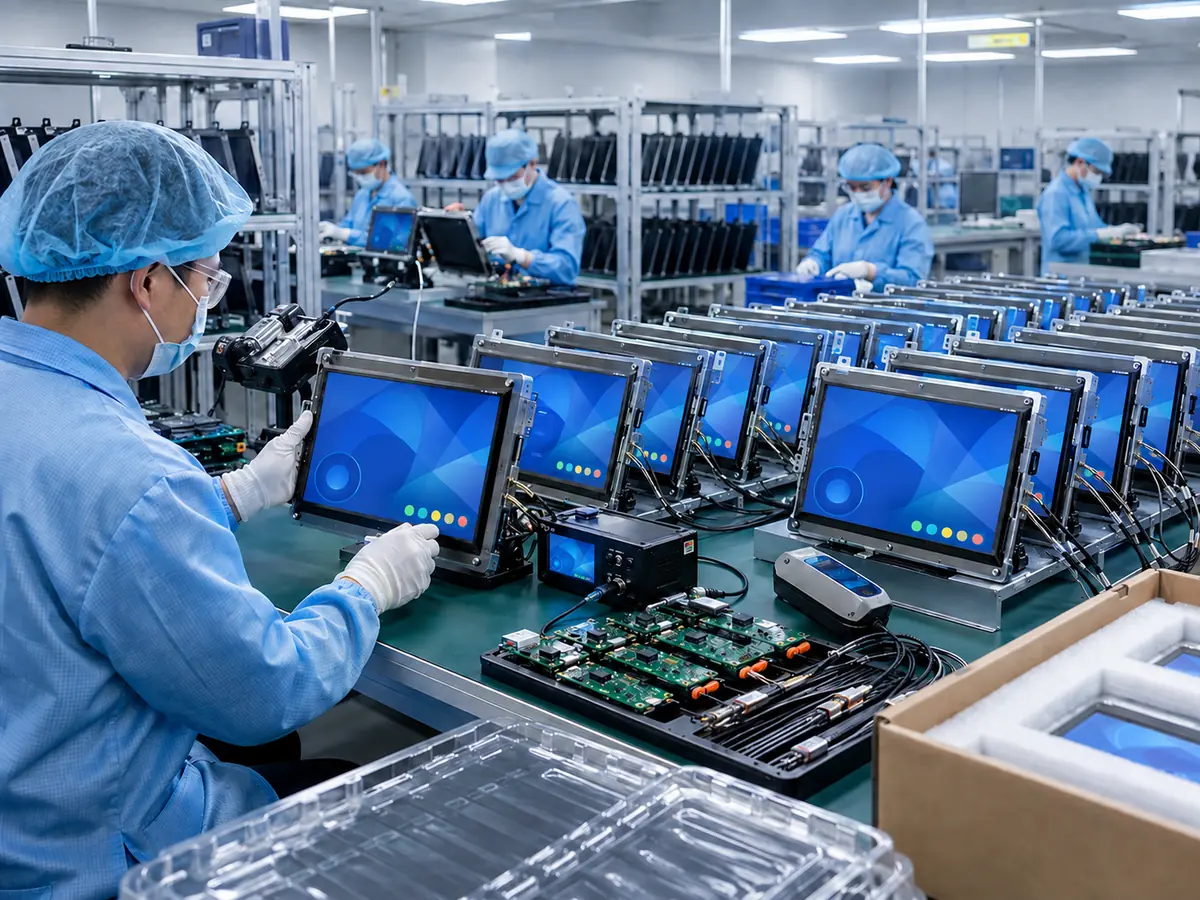
XIANHENG can review the display as a layered assembly. This makes it possible to coordinate the active image area, touch sensor, decorated cover glass, bonding method, mounting structure, and cable direction before tooling or enclosure details are finalized.
Direct answer: XIANHENG can compare industrial TFT LCD panels and develop a matching PCAP or resistive touchscreen, customized cover glass, bonded assembly, cable set, and mechanical concept. Selection can consider size, resolution, brightness, viewing angle, interface, temperature, product status, optical requirements, gloves, cleaning, impact, installation, and available space.
Which Industrial LCD Options Can Be Evaluated?
Depending on the project, XIANHENG can evaluate industrial TFT LCDs from established manufacturers such as BOE, AUO, Innolux, and Tianma. Common robot-project sizes include 7, 8, 10.1, 10.4, 12.1, 15, 15.6, 17, 18.5, 19, 21.5, 23.8, and 27 inches, with other formats considered when the application requires them.
Comparison can cover active area, module outline, resolution, aspect ratio, luminance, contrast, viewing characteristics, surface treatment, interface, connector position, backlight, power, temperature range, mounting, and lifecycle status. Customers can review starting options in the Industrial LCD Product Collection, but the final choice should be based on the complete project data.
Can XIANHENG Support PCAP and Resistive Touch?
Yes. Projected capacitive touch supports a durable glass surface, multi-touch, and gesture-oriented HMIs. Resistive touch remains useful when reliable single-point input with gloves or a stylus is more important than gestures. The decision depends on the operator, environment, cleaning method, software, glass, and electrical conditions.
PCAP development can include sensor dimensions, controller selection, USB or I²C connection, firmware tuning, touch sensitivity, glove response, edge behavior, noise filtering, cable direction, and grounding. Resistive development can consider actuation, tail position, controller compatibility, and overlay structure. A practical comparison is available in When Should You Choose PCAP Over Resistive Touch for Industrial Displays?.
What Can Be Customized in the Cover Glass?
Cover glass can be developed around the equipment rather than treated as a generic overlay. The drawing may define outer dimensions, thickness, viewing window, printed border, brand mark, transparent windows for indicators or sensors, holes, slots, corner radius, edge processing, surface treatment, and adhesive area.
Glass thickness and printed areas influence PCAP performance. Large overhangs, nearby metal, display noise, and grounding can also change the touch response. The final sensor, glass, ink, adhesive, enclosure, and firmware should therefore be qualified together.
When Can Optical Bonding Be Considered?
Optical bonding fills the air gap between the LCD and touchscreen or cover glass with a transparent bonding material. It can reduce internal reflection, improve perceived contrast, reduce parallax, limit contamination within the viewing gap, and create a more integrated assembly.
It is not necessary for every robot. The decision should consider lighting, optical targets, stack construction, temperature, impact, service strategy, cost, and panel suitability. The engineering benefits and tradeoffs are discussed in Why Choose Optical Bonding for Industrial LCD Modules?.
How Can Mechanical Integration Be Reviewed?
XIANHENG can compare drawings for the LCD, touch panel, cover glass, bracket, and available equipment space. Critical details include active-area alignment, bezel overlap, module tolerance, fastening points, gasket compression, adhesive width, cable exit, bend radius, connector access, assembly order, and service removal.
The robot manufacturer remains responsible for the final enclosure, structural analysis, sealing design, safety assessment, and machine qualification. Early drawing exchange helps prevent hidden interference and tolerance problems before samples or tooling are released.
Claim: XIANHENG can coordinate the LCD, touchscreen, cover glass, bonding, and mechanical details as one display assembly. This reduces the risk that individually acceptable components become incompatible after integration.
3. How Can XIANHENG Support Interface Integration and Reliability Validation?
Electrical compatibility is more detailed than matching connector names. Resolution, timing, bit mapping, lanes or channels, pin definition, voltage, power sequence, backlight control, firmware, cable construction, and grounding all affect whether the display starts and remains stable.
Direct answer: XIANHENG can review native LCD interfaces, evaluate controller-board solutions for standard video outputs, develop customized cables, coordinate touch interfaces and firmware, and prepare an assembly for equipment validation. Testing should then cover image, touch, startup, recovery, temperature, vibration, ESD, EMC, power behavior, and long operation using the production-intent robot system.
How Can Native LCD Interfaces Be Matched?
Embedded robot controllers may connect directly to an LCD through LVDS, eDP, MIPI DSI, or parallel RGB. The interface family does not guarantee compatibility. XIANHENG can review native resolution, pixel clock, timing, lane or channel count, color depth, bit mapping, connector, pinout, voltage, power sequence, enable signals, and backlight control.
The host-board documentation and LCD datasheet should be compared line by line. If the existing cable is involved, both connector ends, orientation, shield, length, and continuity must be known. The main interface options are explained in What Display Interfaces Are Used in Industrial Robots?.
Can XIANHENG Support Standard Video Inputs?
When a robot computer provides HDMI, DisplayPort, DVI, or VGA and the LCD requires a native signal, a display controller may be used. XIANHENG can evaluate a controller and coordinate its firmware, supported resolution, output mapping, backlight behavior, power, connectors, and cable with the selected panel.
The completed configuration should be tested for cold start, restart, power cycling, source detection, resolution selection, EDID behavior where applicable, signal interruption, and recovery. A board that shows an image on the bench is not automatically qualified for the robot.
How Are Customized Cables Developed?
Customized display and touch cables can be prepared around the required connectors, pin definitions, length, shielding, grounding, cable direction, bend radius, retention, and service access. Drawings should identify both mating connectors, pin numbering, critical dimensions, and electrical requirements.
Long cable routes, high-resolution signals, repeated pendant movement, vibration, or proximity to motors and drives can increase risk. Signal integrity and mechanical strain relief should be evaluated in the installed equipment rather than inferred from the cable appearance.
How Can Touch Firmware Be Coordinated?
A PCAP sensor that works with bare fingers on the bench may behave differently behind thick glass, with gloves, near grounded metal, or while servo drives are active. XIANHENG can coordinate controller selection and firmware parameters for sensitivity, filtering, edge response, touch thresholds, and the intended USB or I²C connection.
Testing should use the production operating system, drivers, display scaling, HMI orientation, enclosure, glass, cables, power supply, and grounding. Touch coordinates must remain aligned at edges and on small controls. Related tuning principles are described in How Does Touch Firmware Tuning Improve Industrial LCD Responsiveness?.
Why Must EMC and ESD Be Evaluated at System Level?
Robot cells contain servo drives, motors, inverters, contactors, switching supplies, welders, cameras, and long cable runs. These can expose weaknesses that are invisible during quiet bench testing. Symptoms may include image flicker, link loss, corrupted pixels, controller resets, missed touches, or false touches.
XIANHENG can support review of display cables, touch grounding, controller configuration, and assembly details. The robot manufacturer should define the applicable compliance plan and validate the completed equipment through the required EMC, ESD, electrical-safety, and environmental tests.
Which Environmental Tests May Be Relevant?
Depending on the robot, validation may include operating and storage temperature, humidity, thermal cycling, vibration, shock, drop testing for pendants, cable movement, connector retention, cleaning exposure, dust or moisture protection, power cycling, and long-duration operation.
The test profile must come from the actual application and applicable standards. A teach pendant, fixed cabinet, welding cell, and mobile robot do not share the same stress conditions. Broader failure mechanisms are reviewed in How Do Environmental Factors Impact Industrial LCD Reliability?.
What Is the Boundary Between Display Support and Functional Safety?
The HMI may present mode, protective-stop status, interlock information, alarms, or recovery instructions. However, a standard LCD or touchscreen does not become a safety-rated control merely because it shows safety information. Emergency stop, enabling devices, protective functions, and safety-related control must remain within the validated robot safety architecture.
XIANHENG can support the display and touch subsystem, while the robot manufacturer or system integrator remains responsible for hazard analysis, safety architecture, compliance, and final machine validation. The distinction is discussed further in What Role Do Industrial Displays Play in Functional Safety Systems?.
Claim: XIANHENG can support interface, controller, firmware, cable, and touch coordination, but reliable approval requires system-level evidence from the intended robot host, enclosure, software, power, grounding, environmental conditions, and electrical-noise environment.
4. How Does XIANHENG Support Prototypes, Production, and Lifecycle Management?
A successful prototype is the beginning of configuration control, not the end of the project. The approved LCD, touch controller, firmware, glass, bonding, display controller, cables, and drawings must be identifiable so production units can reproduce the tested behavior.
Direct answer: XIANHENG can support requirement review, drawing confirmation, sample preparation, production-intent assembly, inspection planning, configuration records, change communication, failure review, obsolete-panel replacement, and long-term supply planning. The level of control should match the robot manufacturer’s risk, volume, service commitment, and qualification requirements.
What Happens During the Requirement Review?
The review compares the requested functions with available panels, touch technology, glass design, interface, controller, cable, mechanical space, environment, and lifecycle. Missing information and incompatible assumptions should be identified before custom parts are released.
Outputs may include candidate panel specifications, mechanical drawings, interface details, touch and glass proposals, cable drawings, controller configuration, and a list of items that the customer must verify in the completed equipment.
How Can XIANHENG Support Prototype Samples?
Prototype support can include LCD sourcing, touchscreen and cover-glass development, air or optical bonding, controller programming, customized cables, assembly, and initial image and touch inspection. The exact scope depends on whether the customer needs a bare LCD, TP plus LCM assembly, open-frame unit, or complete display solution.
A representative sample should use production-intent materials and recorded firmware wherever practical. If an engineering substitute is used, it should be marked clearly and replaced before final approval.
What Should the Robot Manufacturer Validate?
The customer should test the sample with the intended host board, BIOS, operating system, graphics driver, HMI software, power supply, enclosure, grounding, cables, gloves, cleaning method, robot electronics, and startup sequence. Testing should include routine operation, teaching, alarms, recovery, maintenance, power interruption, and relevant environmental stresses.
Results should be documented with the exact hardware and firmware versions. Approval of a loose display on a workbench does not demonstrate installed-equipment compatibility.
How Can Production Inspection Be Defined?
Depending on the agreed specification, inspection can cover model and component identity, appearance, dimensions, connector and cable condition, image quality, native resolution, luminance, color or uniformity criteria, touch mapping, firmware version, startup behavior, bonding appearance, adhesive, labeling, and packaging.
Acceptance limits should be agreed before volume production. Requirements that are not measurable or recorded are difficult to enforce consistently, especially when optical appearance is judged subjectively.
What Must Remain Under Configuration Control?
Controlled items may include the LCD manufacturer and revision, touch sensor, touch-controller IC, firmware, cover-glass drawing and ink, bonding material, display controller and firmware, cables, connectors, backlight settings, mechanical parts, labels, packaging, and inspection criteria.
On the customer side, the host board, BIOS, operating system, graphics driver, resolution, HMI version, power supply, grounding, enclosure, and assembly method also affect behavior. A change-notification process should define which changes require review, samples, or renewed testing.
How Can XIANHENG Support Obsolete Display Replacement?
Replacement begins with a detailed comparison of the original and candidate displays. Size and resolution are not enough. The review should cover active area, outline, mounting, thickness, interface, connector, pinout, voltage, timing, color depth, backlight, viewing angle, brightness, temperature, touch structure, cable, controller, software behavior, and product status.
If no drop-in panel exists, XIANHENG can help define a controlled redesign involving a new cable, controller, bracket, glass, touchscreen, firmware, or HMI layout. The robot manufacturer should then repeat the validation affected by those changes.
How Can Long-Term Supply Risk Be Managed?
Lifecycle planning can consider panel status, forecast quantity, procurement cycle, safety stock, approved alternatives, change notification, end-of-life information, and last-time-buy requirements. Customers should share realistic demand forecasts and service obligations so that purchasing decisions reflect both production and field replacement needs.
Industrial LCD availability cannot be guaranteed indefinitely, but earlier planning creates more options than reacting after discontinuation. The business and engineering implications are explained in Why Is Long-Term Availability Critical for Industrial LCD Screen Selection?.
Claim: Production support depends on reproducibility. The approved display configuration, inspection criteria, change rules, supply plan, and failure records should preserve the evidence established during prototype validation.
5. What Advantages Does XIANHENG Offer for Industrial Robot Display Projects?
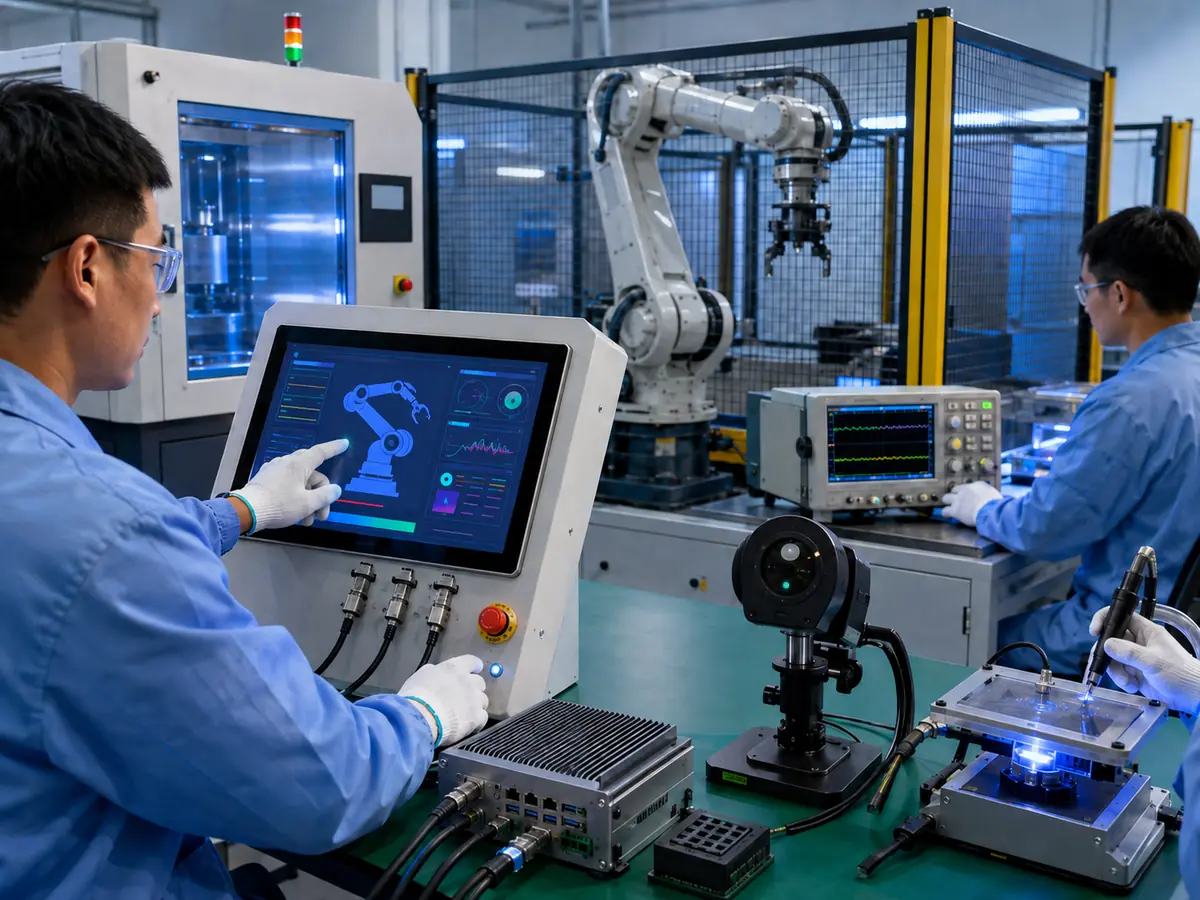
XIANHENG supports robot manufacturers and integrators from early selection through customized assembly and production coordination. This is useful when the project needs more than an off-the-shelf panel or when several display components must be matched to an existing robot platform.
Direct answer: XIANHENG combines access to industrial TFT LCDs with touchscreen development, customized cover glass, bonding, controller boards, cables, firmware coordination, sample assembly, inspection, replacement evaluation, and lifecycle planning. Customers can discuss these elements with one display-project team while retaining responsibility for the final robot design, compliance, safety, and system qualification.
How Does One-Project Coordination Reduce Integration Risk?
When the LCD, touchscreen, glass, bonding, controller, and cables come from unrelated sources, interface boundaries can become unclear. One supplier may approve the panel while another changes the touch firmware or cable construction. XIANHENG can coordinate these display-subsystem elements against a common drawing and project requirement.
This does not remove the need for customer validation. It creates a clearer configuration to test, document, purchase, and reproduce.
Can XIANHENG Support Both New Designs and Existing Robots?
For a new robot, support can begin with the HMI function, host architecture, target size, environment, touch method, and enclosure concept. Candidate components can be reviewed before mechanical release.
For an existing robot, support can begin with the original display assembly and the problem to be solved. That problem may be discontinuation, inadequate brightness, poor touch behavior, unavailable cables, a new host board, or the need to integrate the screen into a revised enclosure.
Can XIANHENG Support Different Levels of Integration?
Depending on the project, XIANHENG can support a standalone LCD panel, a touchscreen plus LCD assembly, a customized cover-glass module, an optically bonded display, a controller-and-cable set, an open-frame display, or a more complete touch monitor. Selecting the correct level avoids paying for unnecessary hardware while keeping difficult interfaces under control.
What Information Should Customers Send to XIANHENG?
For a new project, send the robot application, screen location, desired size and resolution, host output, operating system, brightness, viewing angle, touchscreen method, gloves, cover-glass drawing, available space, cable direction, power, temperature, vibration, annual quantity, schedule, and lifecycle target.
For a replacement project, also send the original LCD, touch, controller, and cable models; datasheets and drawings; connector and assembly photographs; software resolution; current symptoms; and any working samples. Sensitive system information can be limited to what is necessary for compatibility review.
How Can a Robot Manufacturer Start the Project?
Begin with the application and the constraint that is hardest to change. This may be the host interface, enclosure opening, legacy resolution, touch requirement, environmental condition, or long service period. XIANHENG can then identify the remaining information, compare candidate solutions, and define a sample scope.
To discuss an industrial robot LCD, teach-pendant touchscreen, controller-cabinet HMI, collaborative-robot display, AMR interface, vision monitor, customized display assembly, or obsolete-panel replacement, please reach out to XIANHENG.
Claim: XIANHENG supports industrial robot manufacturers with coordinated display engineering—from LCD and touchscreen selection through glass, bonding, controllers, cables, samples, production control, replacement evaluation, and lifecycle planning—while keeping final system validation and safety responsibility clearly defined.


